Most Moon calendars online quietly assume one timezone, which is why a full Moon can appear on different dates depending on which site you check. This one is calculated from the Moon’s actual position and shown in your device’s timezone, so the dates match your sky.
| Date | Phase | Time | Sign |
|---|---|---|---|
| Tue, Nov 24, 2026 | ○ Full Moon | 2:54 PM | Gemini |
| Wed, Dec 9, 2026 | ● New Moon | 12:52 AM | Sagittarius |
| Thu, Dec 24, 2026 | ○ Full Moon | 1:28 AM | Cancer |
| Thu, Jan 7, 2027 | ● New Moon | 8:25 PM | Capricorn |
| Fri, Jan 22, 2027 | ○ Full Moon | 12:17 PM | Leo |
| Sat, Feb 6, 2027 | ● New Moon | 3:56 PM | Aquarius |
| Sat, Feb 20, 2027 | ○ Full Moon | 11:24 PM | Virgo |
| Mon, Mar 8, 2027 | ● New Moon | 9:30 AM | Pisces |
| Mon, Mar 22, 2027 | ○ Full Moon | 10:44 AM | Libra |
| Tue, Apr 6, 2027 | ● New Moon | 11:51 PM | Aries |
| Tue, Apr 20, 2027 | ○ Full Moon | 10:27 PM | Scorpio |
| Thu, May 6, 2027 | ● New Moon | 10:59 AM | Taurus |
| Thu, May 20, 2027 | ○ Full Moon | 10:59 AM | Scorpio |
| Fri, Jun 4, 2027 | ● New Moon | 7:40 PM | Gemini |
| Sat, Jun 19, 2027 | ○ Full Moon | 12:45 AM | Sagittarius |
| Sun, Jul 4, 2027 | ● New Moon | 3:02 AM | Cancer |
| Sun, Jul 18, 2027 | ○ Full Moon | 3:45 PM | Capricorn |
| Mon, Aug 2, 2027 | ● New Moon | 10:05 AM | Leo |
| Tue, Aug 17, 2027 | ○ Full Moon | 7:29 AM | Aquarius |
| Tue, Aug 31, 2027 | ● New Moon | 5:41 PM | Virgo |
| Wed, Sep 15, 2027 | ○ Full Moon | 11:04 PM | Pisces |
| Thu, Sep 30, 2027 | ● New Moon | 2:36 AM | Libra |
| Fri, Oct 15, 2027 | ○ Full Moon | 1:47 PM | Aries |
| Fri, Oct 29, 2027 | ● New Moon | 1:37 PM | Scorpio |
| Sun, Nov 14, 2027 | ○ Full Moon | 3:26 AM | Taurus |
One moment, many calendar dates
A new or full Moon isn’t a whole day; it’s a precise instant, defined by geometry. Everyone on Earth shares that instant, but not the clock reading. If a full Moon happens at 2:30 a.m. in New York, it’s still the previous evening in Los Angeles, and mid-morning in London. Same Moon, same moment, two different dates.
That’s why the table above converts each phase to your local time. If you travel, or if you’re comparing notes with a friend in another country, it’s normal for the dates to differ by one. Neither of you has it wrong.
What new and full Moons actually are
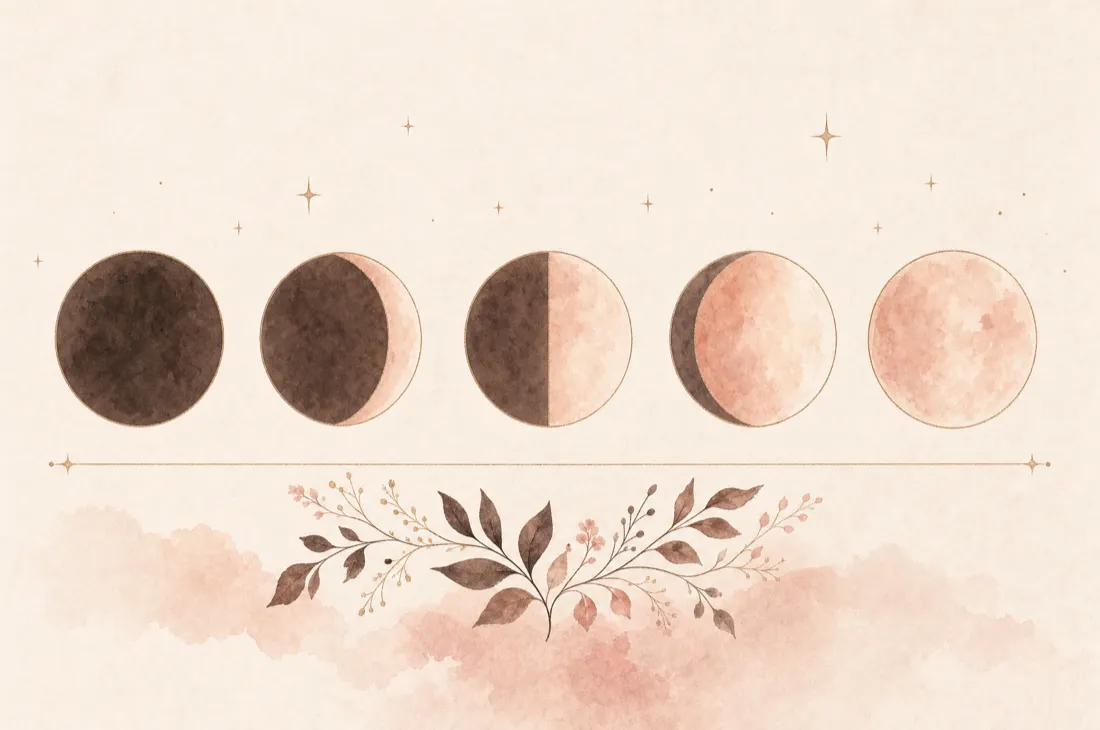
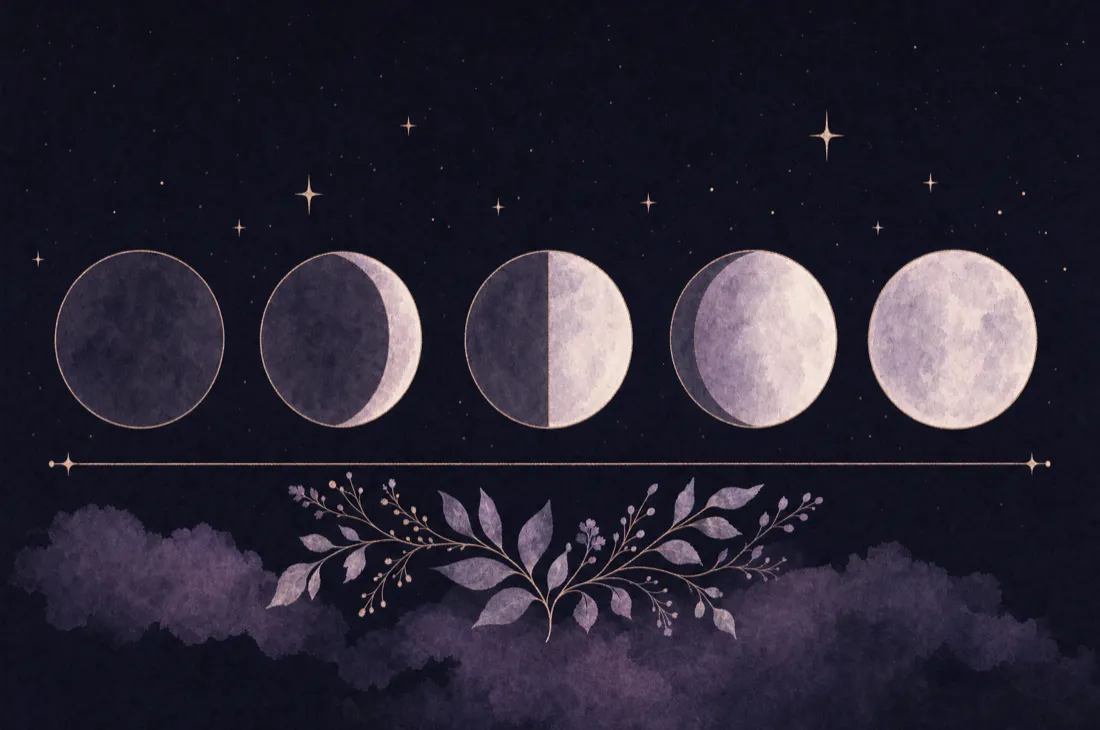
The Moon doesn’t make its own light; we see the part of it lit by the Sun. As it orbits Earth, the angle between the Sun and the Moon, seen from here, changes, and so does how much of the lit side faces us.
- New Moon: the Moon and the Sun line up in the same direction from Earth, at the same zodiac longitude. The lit side faces away from us, so the Moon is invisible, lost in the Sun’s glare. A thin crescent usually appears in the evening sky a day or two later.
- Full Moon: the Moon is opposite the Sun, 180 degrees away. The whole lit face points toward us, and the Moon rises around sunset and sets around sunrise.
- Quarter Moons: halfway between, the Moon is 90 degrees from the Sun and appears half lit.
A full cycle from one new Moon to the next takes about 29.5 days on average. That’s longer than the roughly 27.3 days the Moon takes to circle the zodiac once, because the Sun has moved on in the meantime and the Moon needs a couple of extra days to catch up.
Which sign a phase falls in
Astrologers describe each phase by the zodiac sign the Moon occupies at that moment. At a new Moon, the Moon and the Sun share a sign, so new Moons move through the zodiac in step with the Sun’s yearly path: roughly one sign each month. At a full Moon, the Moon sits in the sign opposite the Sun, so a full Moon in your birthday month usually lands in the sign across from your Sun sign.
Many people treat new Moons as a time to start or set an intention and full Moons as a time to notice what has come to light or to let something go. That’s a reflective tradition rather than an astronomical fact, but it’s a gentle rhythm, and it pairs well with a journal. Our guide to starting an astrology journal has prompts for both.
Thirteen full Moons and blue Moons
Twelve lunar cycles add up to about 354 days, eleven days short of a calendar year. Those extra days accumulate, so every two or three years a calendar year holds thirteen full Moons instead of twelve.
That’s where “blue moon” comes from, and it has two common meanings. The popular modern one is the second full Moon within a single calendar month. An older one, from farmers’ almanacs, is the third full Moon in a season that contains four. Neither Moon looks blue; the name is about rarity. The phrase “once in a blue moon” predates both definitions.
Eclipses, calmly
The Moon’s orbit is tilted slightly against Earth’s, so most months the new Moon passes a little above or below the Sun and the full Moon misses Earth’s shadow. A few times a year, a new or full Moon happens close to the points where those two paths cross, called the lunar nodes. Then a solar eclipse (at new Moon) or a lunar eclipse (at full Moon) can occur.
Eclipses come in seasons, usually about six months apart. Astrologers often read them as times of change or turning points. You don’t need to brace for them: plenty of people simply enjoy them as a chance to look up. If you want to see where an eclipse falls in your own chart, Transits shows the sky against your birth positions.
Using the calendar
Bookmark this page, or copy the dates you care about into your own calendar. If you want more detail for the month at hand, including the Moon’s sign day by day and its moments of crossing your own planets, the Moon calendar in natal shows the whole month for your location.